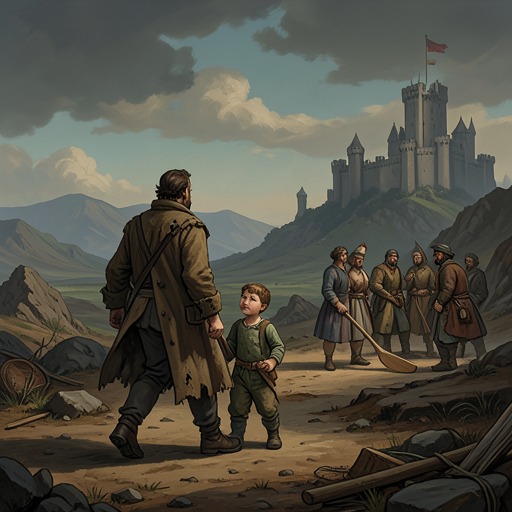
The Count of Antwerp Is Exonerated and Restored to His Rank
The DecameronThe restoration of Gautier of Antwerp turns years of concealed identity and inherited hardship into a public reversal: the exiled count, serving anonymously as a horseboy, is recognized by his son and received back into his former rank by the King of France. The change begins not with a discovery by the authorities but with the confession of the queen whose wrongdoing had caused his banishment; it culminates in the king embracing the man he had wronged and restoring him to an estate greater than before.
Exile and the scattered family
Gautier’s return to favor follows a long separation from his children. Eighteen years after fleeing Paris, he had endured a poor and difficult life in Ireland. His changed appearance made him unrecognizable: old, gray-haired, bearded, lean, and darkened by hardship. Wanting news of his children, he left the person with whom he had long lived and traveled first to England, where he learned that Perrot had risen to become a marshal and a great lord.
The children’s lives had been shaped by the same dispersal. Perrot had grown up in Wales in the household of the English king’s marshal, becoming renowned as a capable and formidable man-at-arms. When a pestilence killed the marshal, his wife, their only son, and many of their kin, the marshal’s daughter inherited the family’s lands. With the approval of surviving local gentlemen, she married Perrot and made him lord of the inheritance; the King of England later appointed him marshal in his dead patron’s place.
Gautier’s daughter, Violante, had likewise survived and married. After finding Perrot established in England, Gautier went to London and cautiously made inquiries about her. He discovered that she had married Jamy Lamiens, the son of the marshal who had raised Perrot. The news that both children were alive and prosperous made Gautier count his past suffering as a small price for finding them again. Yet he did not reveal himself: his appearance had altered so completely that Violante did not recognize him, even when they met.
The hidden father in the household
Gautier approached Violante’s home as a poor stranger, lingering near it until Jamy noticed him and, out of pity, ordered that he be brought inside and fed. The children gathered around the old man, caressing him as though some unspoken instinct had told them he was their grandfather. Gautier, recognizing them as his grandchildren, fondled them in return. Their distress when the household governor tried to draw them away briefly exposed the warmth of the encounter before anyone understood its cause.
Violante came out and scolded the children, still unable to identify her father. Jamy’s father, who despised her, seized on the scene to insult her origins, calling her the daughter of a vagabond and suggesting that her children were naturally drawn to vagabonds. Gautier heard the affront but endured it, as he had endured other indignities. Jamy, moved by the children’s attachment and unwilling to see them weep, nevertheless offered the stranger a place in the household if he wished to remain. Gautier said he knew only how to tend horses, the work he had practiced all his life. A horse was assigned to him, and he stayed on, caring for it and amusing the children while his own daughter remained ignorant of his identity.
A confession changes the political order
The possibility of Gautier’s return arose amid a renewed war. After the French king died, his son—married to the queen whose actions had caused Gautier’s exile—succeeded him. When a truce with the Germans expired, war began again. The King of England sent troops under Perrot and Jamy; Gautier went with them, still disguised as a horseboy. Though no one recognized him, he served the army energetically, contributing through both counsel and action beyond what his lowly role required.
During the campaign, the Queen of France became gravely ill and believed she was near death. In confession to the Archbishop of Rouen, she disclosed the wrong Gautier had suffered through her. She did not keep the admission private: before several men of standing, she recounted what had happened and urged them to persuade the king to restore Gautier, if he still lived, or one of his children if he did not. She died soon afterward and was honorably buried.
Once informed of the confession, the King of France regretted the injustice and declared Gautier innocent of the charge that had driven him into exile. He ordered news of Gautier or either of his children to be sought throughout the army and elsewhere, promising a substantial reward for each and intending to restore the count to his former estate and more. The proclamation transforms a concealed family history into a public matter: the king’s offer can reunite the scattered family, but only if Gautier is willing to step forward.
Recognition and restoration
Hearing the proclamation in his assumed role as a horseboy, Gautier became convinced that it was genuine rather than a trap. He went to Jamy and asked him to accompany him to Perrot, who was already considering revealing his own identity. Once the three were together, Gautier told Perrot that Jamy had married his sister without receiving a dowry and proposed that Jamy claim the king’s reward by identifying Perrot as the son of the Count of Antwerp. Gautier then disclosed that he himself was the count and that Violante was Perrot’s sister and Jamy’s wife. Perrot recognized his father, wept, fell at his feet, and embraced him. Jamy, first astonished and then ashamed of his earlier insults to the horseboy, also knelt and begged forgiveness; Gautier raised him and graciously granted it.
Perrot and Jamy wanted to clothe Gautier properly before presenting him to the king. Gautier refused. He wanted Jamy to present him in his actual horseboy’s condition, both to fulfill the king’s proclamation and to make the contrast with his former rank unmistakable. Jamy appeared before the king with Gautier and Perrot, offering to produce the count and his children. The king ordered a magnificent reward for all three, to be delivered once Jamy had fulfilled his promise. Jamy then identified the horseboy as the father and Perrot as the son, adding that the daughter, his wife, would soon be seen.
Although Gautier was much altered, the king recognized him after looking carefully at him. He raised the kneeling count, kissed and embraced him, and ordered that he immediately receive clothes, servants, horses, and equipment appropriate to his station. Perrot was graciously welcomed, and the king treated Jamy with marked honor while asking to hear the details of the family’s adventures. Gautier urged Jamy to accept the promised gifts and to tell his father that the children were not descended from a vagabond through their mother—a pointed answer to the insult that had gone unanswered when Gautier served in Jamy’s household.
Jamy received the reward and sent for Violante and his mother to come to Paris; Perrot’s wife joined them there. The family reunited in joy, and the King of France reinstated Gautier in all his possessions, making him greater than he had been before. The others returned to their homes with Gautier’s leave, while he remained in Paris in greater honor until his death. The ending thus repairs more than a title: public recognition answers private humiliation, and the apparent vagabond is revealed as the father and grandfather whose place in the family had never truly disappeared.